See Our Latest Blogs
Education That Helps Authors Shine!
From Stranger to Superfan: Using AI to Automate Your Reader Funnel
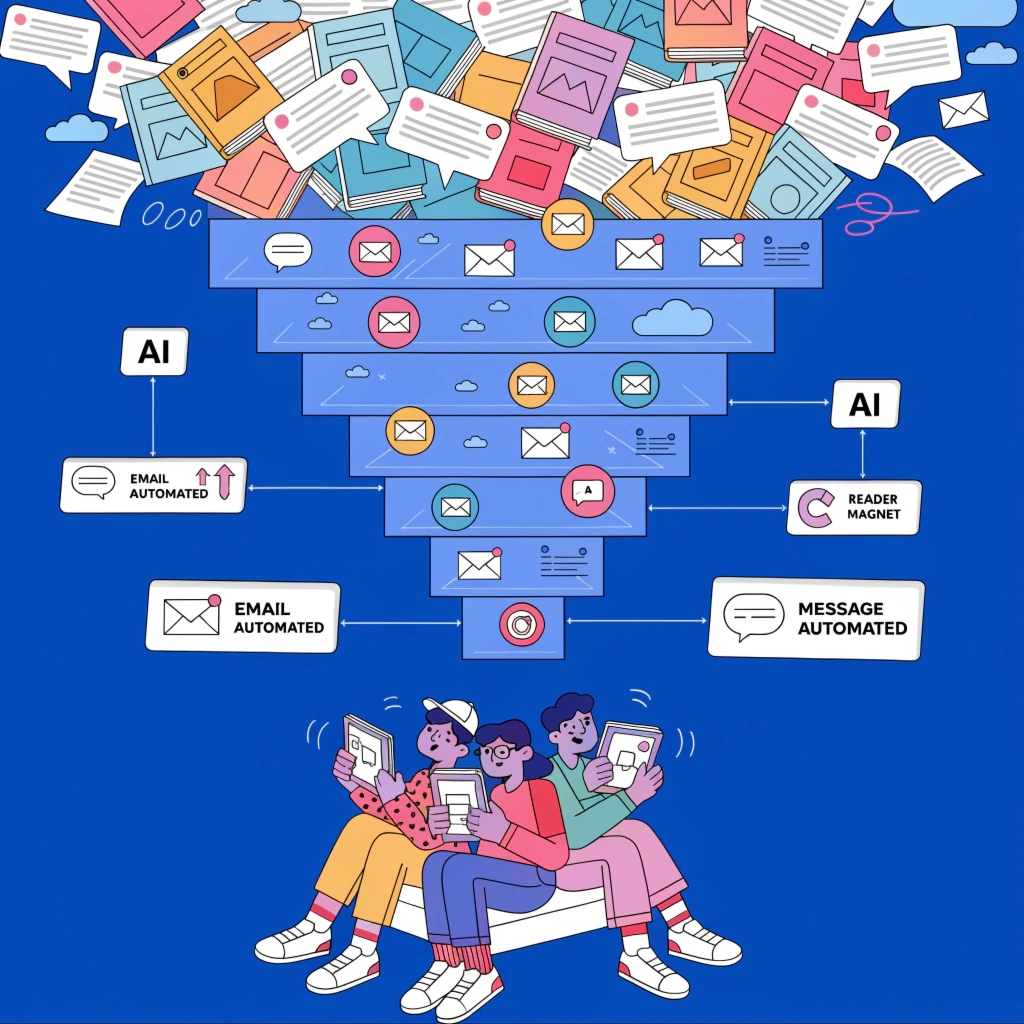
Most authors know they “should” build an email list, create reader magnets, and nurture subscribers with consistent emails—but the actual work of doing it can feel overwhelming. The result is a leaky funnel: readers discover you once, then disappear. AI can help you design and maintain a simple, effective reader journey without turning you into a full‑time marketer.
In this post, we’ll walk through how to use AI to create reader magnets, draft welcome sequences, and streamline your outreach so that strangers don’t just sample your work—they stick around and become superfans.
What a “reader funnel” really is (in plain English)
Forget the jargon for a moment. A reader funnel is simply the path someone takes from “I’ve never heard of you” to “I buy everything you write and tell my friends about it.” For most authors, that path looks like this:
They see you or your book somewhere (social, a podcast, a retailer page, an ad).
They grab something free or low‑risk that interests them (a sample, a bonus, a checklist).
They join your email list and start hearing from you regularly.
Over time, they buy more books, engage with your content, and become fans.
AI doesn’t change the fundamentals; it just helps you build the pieces of that journey faster and with more personalization. Instead of staring at a blank page when you sit down to write a welcome sequence or a lead magnet, you can feed AI your ideas and let it create draft assets you can refine.
Step 1: Use AI to brainstorm and draft a reader magnet
Your reader magnet is often the first “yes” someone gives you. It should feel like a natural extension of your books and brand: something your ideal reader would be excited to download.
You can use AI to:
Brainstorm magnet concepts: “Given this book description and audience, brainstorm 10 reader magnet ideas that would genuinely help or delight them.”
Choose a format: checklist, mini‑guide, bonus scene, character dossier, world‑building map, workbook pages, etc.
Draft the first version: “Write a 1,500‑word guide/bonus scene/checklist based on this outline, in this tone, for this audience.”
Many authors are already using AI tools designed for book content (and companion material) to generate journals, workbooks, and short nonfiction assets that serve as lead magnets. Your job is to edit for voice, ensure the content aligns with your brand, and avoid giving away anything you don’t want used as training data.
Step 2: Let AI draft a high‑converting landing page
Once you have a magnet, you need a place for readers to sign up. A good landing page answers three questions quickly: What is this? Who is it for? Why should I care?
Feed AI:
Your reader magnet description.
A short paragraph about your ideal reader.
Any testimonials, reviews, or social proof you already have.
Then ask it to:
“Write a landing page for this reader magnet, with a strong headline, 3–5 bullet benefits, and a clear call‑to‑action.”
“Suggest 3 headline alternatives emphasizing curiosity, emotional payoff, or speed of result.”
“Give me a shorter version I can use as a section on my main website.”
Modern AI marketing tools are particularly good at generating multiple headline and benefit variations so you can test which resonate best. You still decide what feels ethical and true, but you no longer have to invent every line from scratch.
Step 3: Build a 4–7 email welcome sequence with AI
A welcome sequence is where you turn a new subscriber from a curious stranger into a reader who understands your world, your backlist, and what to expect from you. Building this sequence is a perfect use case for AI.
First, outline the purpose of each email, for example:
Welcome and deliver the magnet.
Introduce you and your story.
Highlight your most compelling book or series.
Share social proof: reviews, awards, or reader stories.
Invite deeper engagement (social, community, events).
Soft pitch another book or bundle.
Then prompt AI with:
“Create a 6‑email welcome sequence for new subscribers who downloaded this magnet. For each email, include a subject line, preview text, and body copy in a warm, conversational tone.”
“Adjust the tone to match this voice guide and author bio.”
“Offer two versions of Email 3: one for new‑to‑you readers, one for people who already bought Book 1.”
Email tools and sequence builders increasingly use AI to generate multi‑step sequences with subject lines, timing, and body copy based on your goals. You still plug everything into your email service provider, but the heavy lifting of drafting is done for you.
Step 4: Personalize based on reader behavior
One of the most powerful shifts in 2026 is how accessible segmentation has become. You no longer need to be a data nerd to tailor messages based on what subscribers actually do.
AI can help you:
Analyze open and click patterns to group subscribers into “engaged,” “warming up,” and “cold.”
Draft different follow‑up emails based on what link someone clicked (for example, romance vs. suspense, craft vs. business content).
Suggest when to resend or reframe an offer to those who showed interest but didn’t buy.
You might prompt:
“Given this data summary (opens, clicks, top links), suggest 3 audience segments and what they seem most interested in.”
“Write a re‑engagement email for subscribers who haven’t opened in 90 days, with a friendly, low‑pressure tone.”
Indie authors are already using AI this way—feeding subscriber behavior and campaign performance into AI assistants that help them decide what to send next and to whom.
Step 5: Supercharge outreach to partners and promo opportunities
Your funnel doesn’t exist in a vacuum; you also need fresh people coming into the top. AI can accelerate your outreach to reviewers, bloggers, podcasters, and influencers.
Here’s how:
Research: “List 20 podcasts/blogs/newsletters that feature [your genre/topic] and share an audience similar to [comp author].”
Pitch drafting: “Write a personalized pitch email to this podcast host explaining why this topic would serve their audience, referencing recent episodes and my book.”
Follow‑up sequencing: “Create a 3‑email follow‑up sequence for outreach to bloggers who didn’t respond to the first pitch.”
AI‑driven outreach tools are already doing this for sales teams; authors can piggyback on the same capabilities to scale pitches while maintaining a human tone. Again, you review for accuracy and authenticity before anything leaves your inbox.
Step 6: Keep your funnel ethical and genuinely reader‑centric
Automation and AI can easily slide into spammy territory if you’re not careful. The goal is to serve readers better, not overwhelm them.
A few guardrails:
Value first: Make sure every email and magnet delivers genuine value, not just a sales push.
Clear consent: Only add people to your list when they’ve clearly opted in.
Respectful frequency: Use AI to suggest timing, but trust your instincts about how often you’d want to hear from someone.
Honest framing: Avoid overpromising what your magnet or books can deliver.
Authors using AI most effectively are the ones who combine smart automation with a strong sense of integrity. They use technology to support deeper relationships, not to replace them.
When you use AI to build and maintain a simple, reader‑centric funnel, you free up time and mental energy while actually giving your audience a better experience. Instead of losing readers after a single encounter, you’ll have a system that gently invites them closer—turning strangers into subscribers, subscribers into buyers, and buyers into true superfans.

What Our Readers Are Saying!

A.Y. Berthiaume- Award Winning Author of Do Not Write That Book- Until You Read This One

“The Perfect Reader Playbook is as funny as it is useful—authors will find themselves laughing out loud as they work through the prompts while doing the serious work of building their platform.”

Tyler R. Tichelaar, PhD and award-winning author of The Mysteries of Marquette
“The Perfect Reader Playbook by Juliet Clark and Gary MacDermid is a game-changer for authors. Packed with fresh, practical strategies, it shows you exactly how to attract and energize your ideal readers—and turn them into loyal champions for your books. Smart, fun, and unbelievably effective.”
Lin Yuan-Su, Founder of Enlightened Success Institute Multiple Seven-Figure Mindset Trainer and Strategist
"The Perfect Reader Playbook is a powerful and comprehensive tool that helped me gain a much deeper understanding of my ideal clients and their journey. With that clarity, creating aligned marketing strategies and materials became easier and more intuitive. It’s well-structured, easy to use, and incredibly insightful. Whether you're just starting out or are well-established in your business, this playbook meets you where you are and adds tremendous value at any stage"
Get In Touch
Email:[email protected]
Unleash Your Business Brilliance.
© 2026 Superbrand Publishing - All Rights Reserved, Salt Lake City, UT